
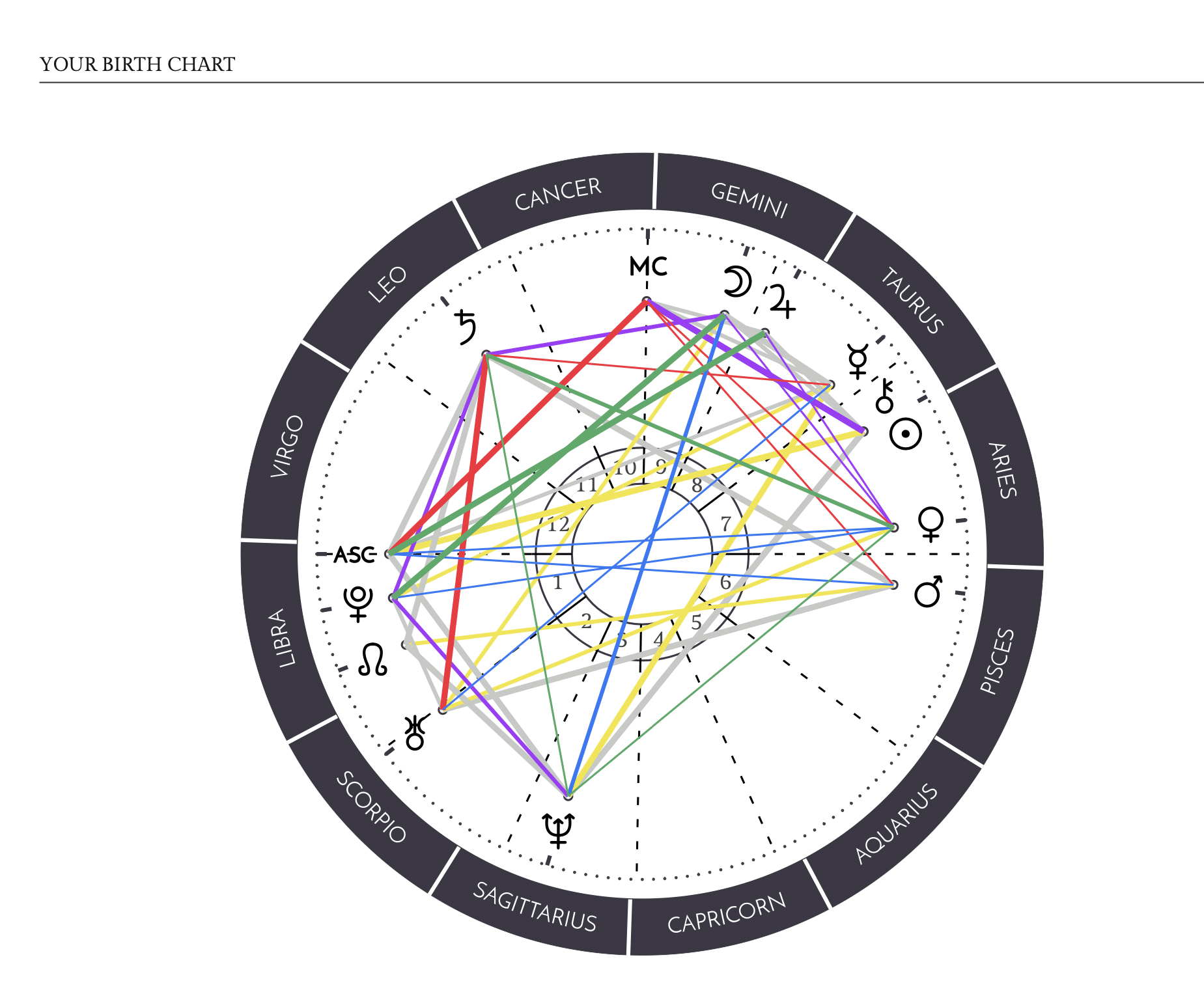
Reading your astrology birth chart can be an enlightening experience, providing insights into your personality, strengths, challenges, and life path. Here’s a step-by-step guide on how to read and interpret your birth chart:
1. Obtain Your Birth Chart
You can generate your birth chart using various online astrology tools or software. You’ll need your birth date, exact time, and place of birth.
2. Identify the Main Components
Your birth chart is divided into several key components:
- Sun Sign: Represents your core identity and personality. It’s determined by your birth date.
- Moon Sign: Reflects your emotional self and inner feelings. This is based on the position of the Moon at your time of birth.
- Rising Sign (Ascendant): Indicates how you present yourself to the world and how others perceive you. It’s determined by your birth time and location.
3. Examine the Houses
The chart is divided into 12 houses, each representing different areas of life:
- 1st House: Self, physical appearance, personality
- 2nd House: Values, possessions, self-worth
- 3rd House: Communication, siblings, learning
- 4th House: Home, family, emotional foundation
- 5th House: Creativity, romance, children
- 6th House: Work, health, daily routines
- 7th House: Partnerships, marriage, one-on-one relationships
- 8th House: Transformation, shared resources, intimacy
- 9th House: Philosophy, travel, higher education
- 10th House: Career, public image, life goals
- 11th House: Friendships, community, aspirations
- 12th House: Spirituality, hidden aspects, subconscious
4. Analyse the Planets
Look at where the planets are located in your chart and in which houses they reside. Each planet represents different aspects of your personality and life experiences:
- Sun: Core self and ego
- Moon: Emotions and instincts
- Mercury: Communication and thought processes
- Venus: Love, relationships, and aesthetics
- Mars: Drive, ambition, and aggression
- Jupiter: Growth, expansion, and luck
- Saturn: Structure, discipline, and challenges
- Uranus: Innovation, change, and individuality
- Neptune: Dreams, intuition, and spirituality
- Pluto: Transformation, power, and rebirth
5. Understand Aspects
Aspects are the angles formed between planets, indicating how they interact with each other. Common aspects include:
- Conjunction (0°): Planets are close together, blending their energies.
- Sextile (60°): Harmonious connection, indicating opportunities.
- Square (90°): Tension and challenges between planets.
- Trine (120°): Easy flow of energy and natural talents.
- Opposition (180°): Polarization and balancing opposite energies.
6. Look for Patterns
Identify any patterns or concentrations of energy in your chart. For example, if many planets are in one house, that area of life may be particularly significant for you.
7. Consider the Elements and Qualities
Elements: Fire, Earth, Air, Water. A balance of elements can indicate a well-rounded personality.
Qualities: Cardinal, Fixed, Mutable. This indicates how you approach life and change.
8. Synthesise the Information
Integrate the insights from the Sun, Moon, Rising sign, houses, planets, and aspects to create a holistic understanding of your birth chart. Reflect on how these elements interact and what they reveal about your personality, challenges, and potential.
Reading your astrology birth chart involves understanding the interplay of various components, including planets, signs, houses, and aspects. This process can reveal valuable insights into your personality, relationships, and life path. As you explore your chart, approach it with curiosity and openness, allowing it to enhance your self-awareness and understanding of your place in the world.