
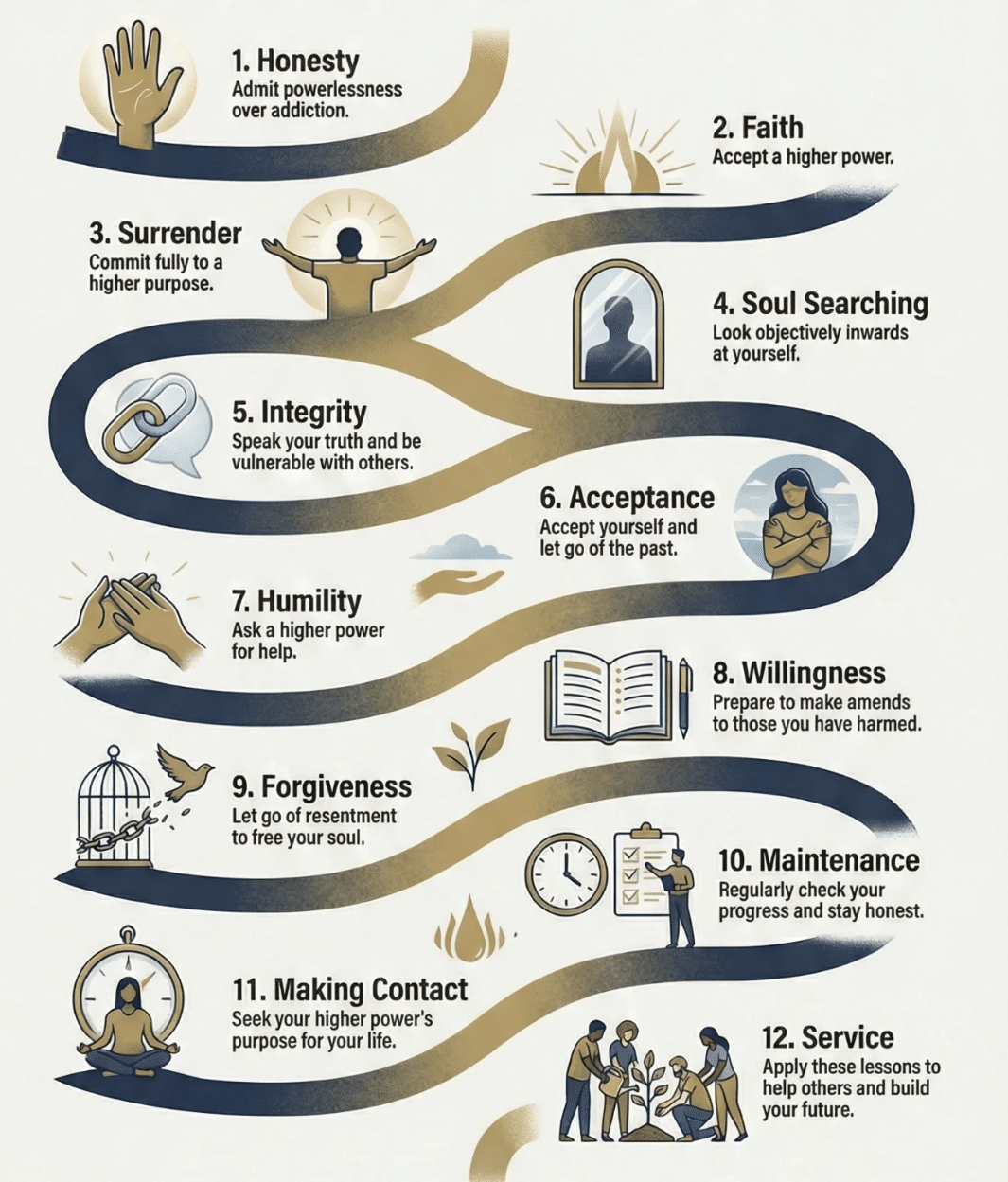
I’ve loved reading about The 12 Steps of Alcoholics Anonymous (AA) or any addiction is a set of guiding principles for individuals seeking recovery from addiction. These steps provide a framework for personal growth, accountability, and community support on the path to sobriety. Here’s a concise overview of each of the 12 steps:
The 12 Steps
1. We admitted we were powerless over the addiction—that our lives had become unmanageable.
Acknowledging the inability to control the addiction and recognising the chaos it has caused in one’s life.
2. Came to believe that a Power greater than ourselves could restore us to sanity.
Developing faith in a higher power or a supportive force capable of facilitating recovery and mental clarity.
3. Made a decision to turn our will and our lives over to the care of God/Universe/Source as we understood Him.
Committing to surrendering control and trusting in a higher power or supportive framework for guidance.
4. Made a searching and fearless moral inventory of ourselves.
Conducting a thorough self-assessment to identify personal flaws, behaviors, and patterns connected to addiction.
5. Admitted to God/Universe/Source, to ourselves, and to another human being the exact nature of our wrongs.
Taking responsibility for wrongdoing and sharing this inventory with a higher power and another person to foster accountability.
6. We’re entirely ready to have God/Universe/Source remove all these defects of character.
Being open and willing to let go of harmful traits and behaviors that hinder recovery and personal growth.
7. Humbly asked Him to remove our shortcomings.
Seeking assistance from a higher power to address and eliminate personal deficiencies.
8. Made a list of all persons we had harmed and became willing to make amends to them all.
Reflecting on the harm caused to others and preparing to take steps toward making amends.
9. Made direct amends to such people wherever possible, except when to do so would injure them or others.
Taking action to apologise and rectify past harms while being mindful of the potential impact on others.
10. Continued to take personal inventory and when we were wrong promptly admitted it.
Regularly assessing one’s actions and promptly acknowledging mistakes to maintain accountability and self-awareness.
11. Sought through prayer and meditation to improve our conscious contact with God/Universe/Source as we understood Him, praying only for knowledge of His will for us and the power to carry that out.
Engaging in spiritual practices to deepen the connection with a higher power and seek guidance.
12. Having had a spiritual awakening as the result of these steps, we tried to carry this message and to practice these principles in all our affairs.
Embracing the transformation experienced through the 12 Steps and sharing the message of recovery with others while implementing learned principles in daily life.
The 12 Steps of Alcoholics Anonymous provide a comprehensive framework for individuals seeking to overcome addiction. These steps emphasise self-reflection, personal accountability, and the importance of community support, guiding individuals toward healing and lasting recovery. By engaging with this process, individuals can foster resilience, personal growth, and a deeper sense of connection to themselves and others.
Picture sourced from: https://www.holdfastrecovery.com/blog/12-steps-of-aa-and-na-explained-in-simple-terms/